The Evolving Skills of Product Managers in the Age of VibeCoding
VibeCoding allows product managers to directly turn requirements into functional products, but most outputs are often “usable but rough”—like registration without validation, data without permissions, and processes without closure. The gap lies not in the tools, but in the precision of requirement descriptions. The PRD skills, user perspective, and boundary thinking that product managers have honed over the years have become the most scarce competitive advantages in the AI development era.
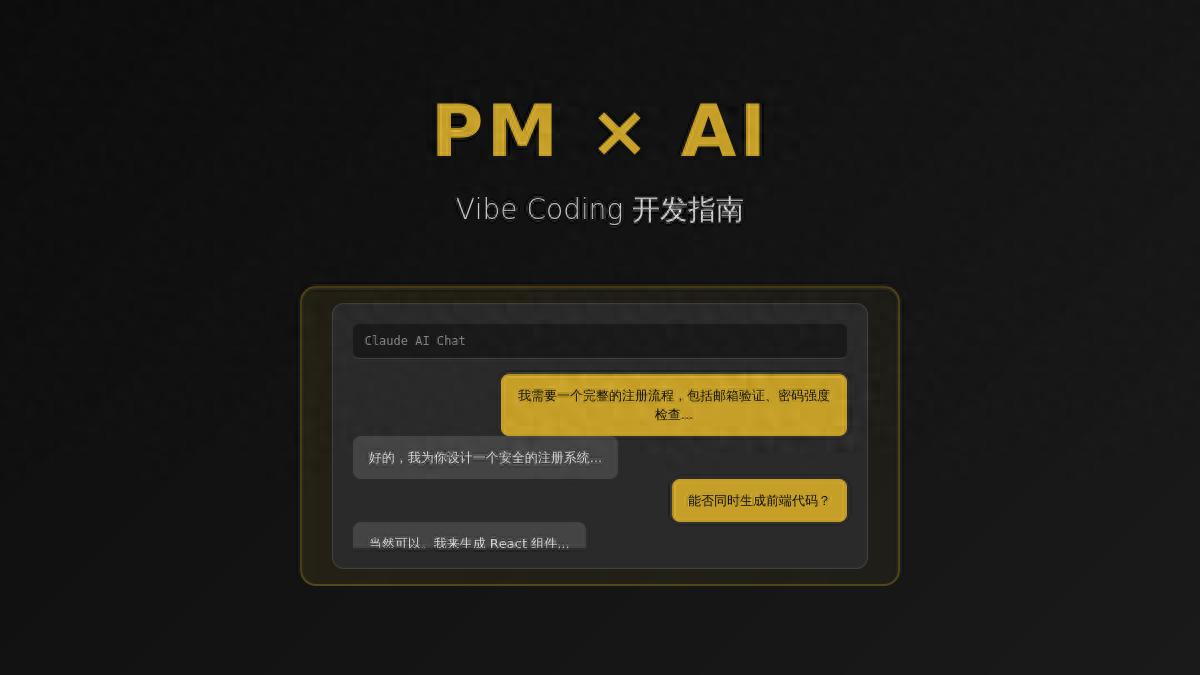
Last week, a friend who works as a product manager sent me a link. It was a functional SaaS tool—user registration, data dashboard, and report export were all included. He excitedly said he created it using AI in just two hours without writing a line of code. After reviewing it, I told him: it works, but this thing will cause problems once launched.
The registration page lacks input validation, allowing users to register with incorrect emails and not receive verification emails; user passwords are stored without encryption, posing a data leakage risk; the data dashboard lacks permission control, allowing anyone to access others’ data by simply modifying a URL; the export function has no frequency limits, making it easy for a script to crash the system, rendering it unusable for all users.
He was stunned. He said he simply told AI to “help me create a user registration feature” and “make a data dashboard,” and it did.
The problem lies here.
1. AI Will Not Think About Boundaries for You
Many product managers understand VibeCoding as: I tell AI what I want, and it writes the code for me. This understanding is not wrong but misses the most critical step.
When you tell AI to “create a user registration feature,” it will indeed do so. However, it only creates something that “can register”—input an email and password, click a button, and store it in the database. What happens if the email format is incorrect, the password is too short, or the email is already registered? What if the network is down? If you don’t specify, AI won’t think of it.
Because it doesn’t know.
AI has never used your product, doesn’t know who your users are, and is unaware of the scenarios that might overwhelm your customer service. It only knows that you gave it a sentence, and it implements it in the most common way.
This is akin to telling a newly hired developer, “help me create a registration feature,” and then walking away. What they produce will likely differ from what you envisioned. It’s not that their capabilities are lacking; it’s that you didn’t communicate clearly.
The difference is: when collaborating with a person, the other party might ask questions; when collaborating with AI, if you don’t ask, it won’t tell.
PM Perspective: This is a familiar issue for product managers. Our daily tasks involve translating “I want an XX” into “in what scenario, for whom, what does success look like, what does failure look like, and where are the boundaries?” The quality of the PRD directly determines whether the development output aligns with your expectations. In the VibeCoding era, this logic hasn’t changed; it’s just that the recipient has shifted from developers to AI. And AI requires even more precise descriptions than developers—because it won’t ask you questions proactively. The boundary thinking that product managers have refined over years of writing PRDs has now directly transformed into productivity in AI collaboration.
2. The Precision of Requirement Descriptions Determines AI Output Quality
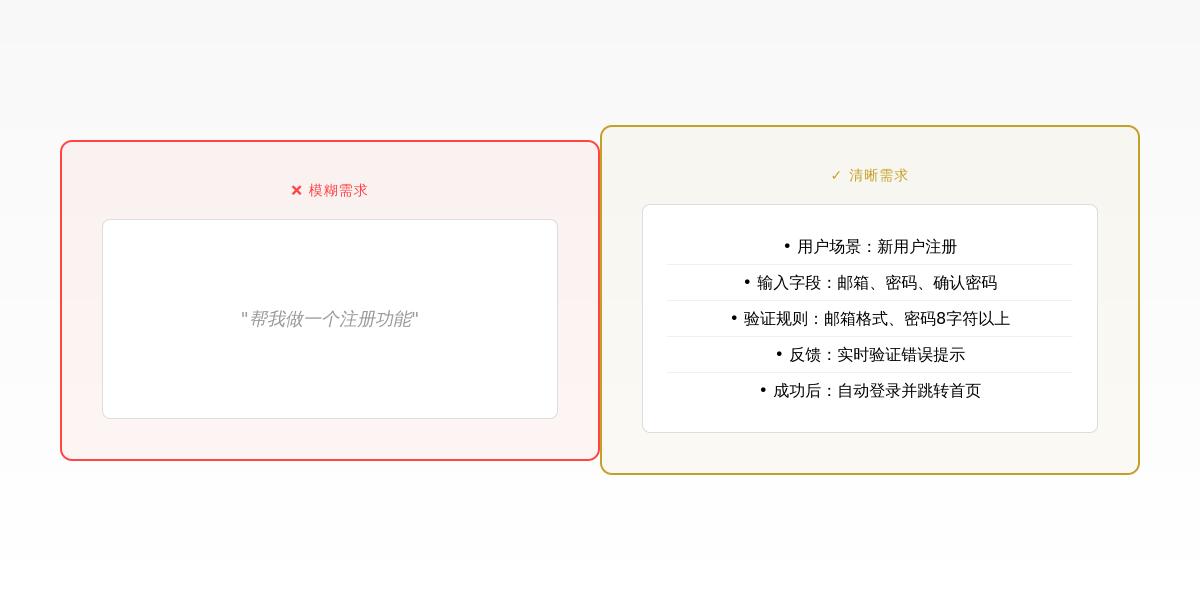
Let me provide a concrete comparison.
Low Precision Description:
“Help me write a user registration feature.”
AI Output: A basic registration form with email and password fields that, upon submission, stores the data. No validation, no verification emails, no error messages, and no prevention of duplicate registrations.
High Precision Description:
“Users register via phone number, entering their phone number to receive a verification code valid for 5 minutes. Upon successful registration, they enter a guided process to complete their profile and select interest tags. If the phone number is already registered, prompt ‘This phone number is already registered, please log in directly.’ At the bottom of the registration page, display links to the user agreement and privacy policy.”
AI Output: A complete registration process with verification code validation, a guided process, error handling, and compliant user agreements.
The difference between the two descriptions is vast.
Where does the difference lie? Four dimensions:
| Dimension | Low Precision | High Precision |
|---|---|---|
| Who is the user | “User” | “Newly registered user” |
| What is the scenario | “Click register” | “On the registration page, input phone number, click to get verification code” |
| What is success | “Just need to register” | “Upon successful registration, enter the guided process, complete profile in 5 steps” |
| What is failure | (not specified) | “Prompt ‘Please enter a valid phone number’ for incorrect format, ‘Verification code expired, please retrieve again’ for expired code” |
These four dimensions are something product managers can recite in their sleep—this is precisely what we emphasize when writing PRDs about “user stories” and “acceptance criteria,” right?
PM Perspective: Years of PRD writing experience directly translates into productivity in the VibeCoding era. Spending 10 minutes crafting a clear requirement description allows AI to produce a complete feature in 5 minutes. Others may spend 1 minute stating a vague request, and AI will take 5 minutes to produce a half-finished product requiring multiple revisions. Investing 10 minutes instead of 1 minute yields a return of 5 minutes versus 5 hours of rework.
3. Context Engineering: Writing a Brief for AI is Like Writing One for Your Boss
Recently, a concept has gained popularity in the AI development community called “Context Engineering.” It sounds sophisticated, but it essentially involves ensuring that AI fully understands your project background before beginning any work.
In terms that product managers can relate to—when onboarding a new intern, you wouldn’t start from scratch each time by explaining “what our company does, who the target users are, and the business background of this feature.” You would provide them with a project brief to read before taking on tasks.
Context Engineering is about writing a brief for AI.
Specifically, product managers need to maintain three documents:
First Document: Product Background Document. Clearly state what this product is, who it serves, and what problem it solves. Outline the core business processes, key roles, and what absolutely cannot be done. This is like the project background email you send to a new colleague.
Second Document: Product Requirement Document. A detailed description of each feature—how users will operate, what success looks like, what failure messages will be displayed, and what the boundary conditions are. This is the PRD, but instead of being written for developers, it’s now written for AI.
Third Document: Product Boundary Document. Define which features will be developed, which will not, and their priorities. This is the familiar task of defining feature scope, helping AI understand “what should be modified and what should not.”
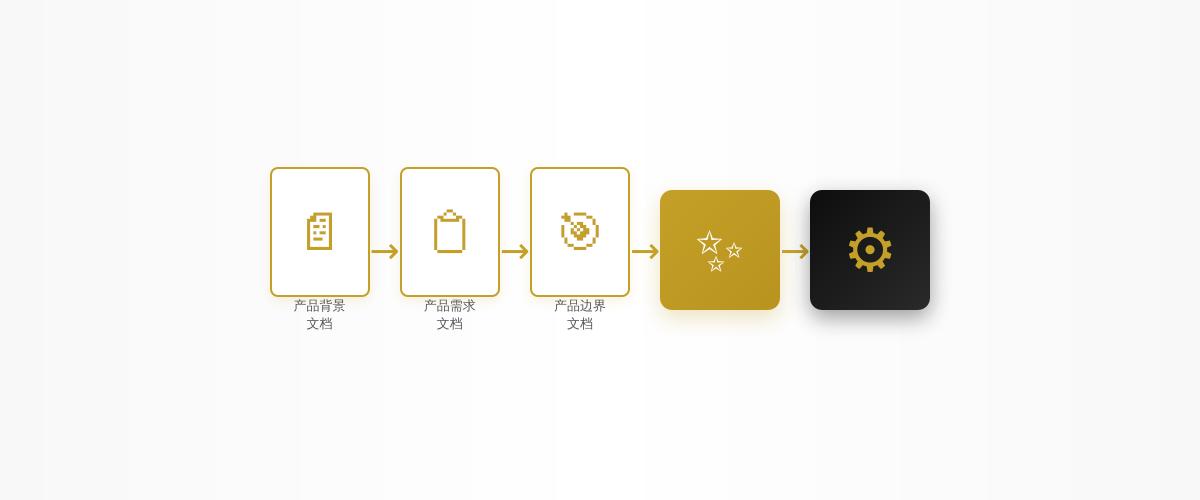
Once these three documents are prepared, every time you start a new conversation with AI, it first reads these documents, gaining a complete understanding of your project. When you then say, “help me create a registration feature,” it will know your business background, user profiles, and error handling style, resulting in a vastly improved output quality.
Some might argue that this sounds too cumbersome; they just want to quickly create a prototype.
But think about it—before proposing to your boss, do you need to write a brief? Before leading a team on a project, do you need to clarify the requirement documents? These tasks are already part of your responsibilities. The only difference is that previously you handed the documents to the development team, and now you hand them to AI.
The only distinction is that the documents for AI must be more precise. Developers might ask for clarification if they don’t understand, but AI will not.
PM Perspective: Context Engineering is fundamentally a product manager’s “project management ability.” The deeper your understanding of the project and the clearer your documentation, the higher the quality of AI output. This isn’t a new skill; it’s an old skill that PMs have honed over the years—just with a different delivery recipient.
4. Engineers Doing VibeCoding vs PMs Doing VibeCoding
Here’s an interesting comparison.
I know two friends who are both using VibeCoding for their side projects. One is a backend engineer with ten years of experience; the other is a product manager who has never written code.
The engineer friend has efficient conversations with AI, often saying things like “help me implement data isolation using this technology” or “this component should use server-side rendering, not client-side rendering.” The output from AI is technically sound.
However, once the product is completed, issues arise.
The registration process is smooth, but he didn’t consider what users should see after registering—he just dumped a blank dashboard, leaving users unsure of what to do. There’s an export function, but he didn’t think about how the exported file names should include dates and usernames—users download ten files, all named “export.csv,” making it impossible to distinguish between them. The settings page allows password changes, but he didn’t consider how to handle the user after changing their password—the page still shows “successfully modified,” but users don’t realize they’ve been logged out.
On the other hand, the PM friend, who lacks technical details, describes the requirements like this:
“Upon successful registration, users should enter the dashboard for the first time and see a welcome guide that informs them what they can do next. The guide consists of three steps: create the first project, invite a member, and view the data dashboard. Each step is checked off upon completion, and the guide disappears after all three steps are completed.”
The AI output from her description is complete, with a closed process and a coherent user experience.
Where does the difference lie? Engineers focus on “how to implement this feature,” while PMs focus on “how users will use this feature.”
AI lacks implementation capability; it lacks the clarity of thought. And “thinking clearly about what to do” is precisely what product managers do every day.
PM Perspective: In the VibeCoding era, “thinking clearly about what to do” is more valuable than “knowing how to do it.” Engineers excel in articulating technical solutions to AI, while PMs excel in articulating product solutions. As AI’s technical capabilities grow stronger, the “technical solution” phase will be handled by AI itself, while the “product solution”—the requirements themselves—will become the only bottleneck.
5. Five Stages That Product Managers Can Navigate Blindfolded
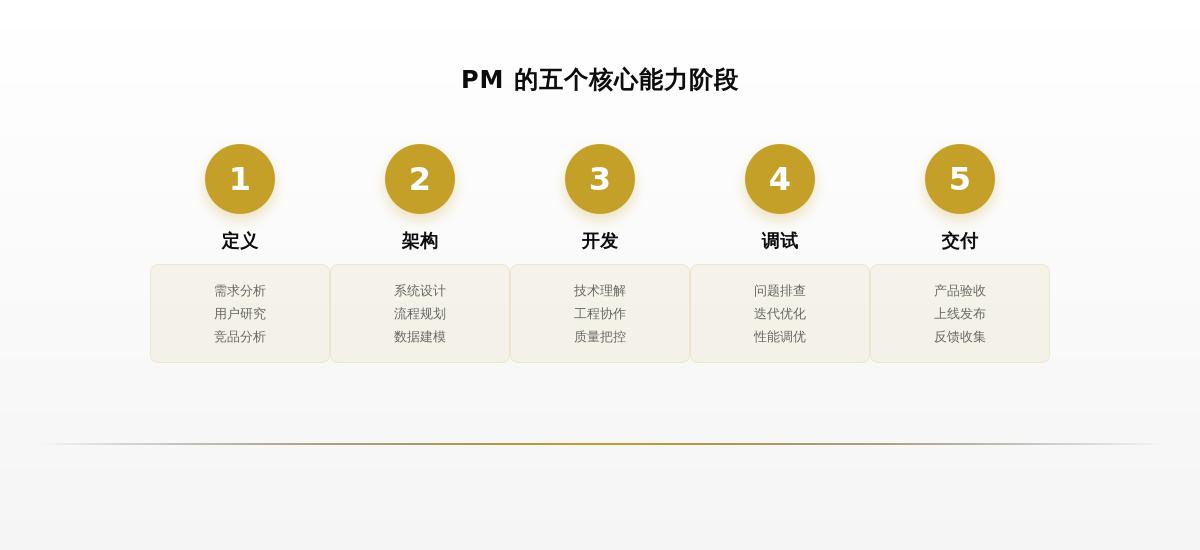
The complete VibeCoding process consists of five stages. I’ll translate it into language that product managers can understand:
Stage One: Definition. You have a vague idea in your mind—“I want to create an XX.” The task in this stage is to transform that vague idea into a clear requirement document. You need to engage in repeated dialogue with AI, allowing it to ask questions until it fully clarifies who the users are, what the core features are, what should not be done, and where the boundaries lie. This is akin to requirement interviews, which PMs do daily—just like when conducting user research, you continuously ask “why” until you uncover the true needs.
Stage Two: Architecture. Define the product solution, build the functional skeleton, and outline data flow. It sounds technical, but it’s essentially information architecture design—what modules the product has, how data flows, which functions are front-end and which are back-end. PMs use the same thinking when conducting competitive analysis and feature breakdowns—just like when you draw a product structure diagram, you first determine the modules and then the relationships between them.
Stage Three: Development. Implement each feature one by one. The key principle is: only work on one feature at a time, validate it, and then move on to the next. If AI takes more than 15 minutes to complete a task, it means your requirements are too large and need to be broken down. This is agile iteration, a rhythm PMs are familiar with—just like when you plan versions, breaking down large requirements into smaller ones and implementing a batch in each iteration.
Stage Four: Debugging. When the product has issues, you need to identify the cause. The key is not to let AI guess, but to provide it with complete context—complete error messages, what actions you took, what you expected, and what you have already tried. This is akin to user feedback analysis, which PMs handle daily—just like when addressing customer complaints, you first clarify “what actions the user took, what they expected, and what actually happened.”
Stage Five: Delivery. The final check before launch—security checks, functional acceptance, and release processes. This is the release checklist that PMs review before each version—just like when you conduct acceptance testing, checking each function against PRD requirements.
Have you noticed? These five stages are ones that product managers can navigate blindfolded. The only difference is that previously you handed the requirements to the development team, and now you hand them to AI.
PM Perspective: VibeCoding hasn’t invented a new process. It has merely replaced the familiar development process for product managers with a different executor. This means that PMs have a low learning curve when adopting VibeCoding—you already have the methodology; you just need to learn how to communicate with AI.
6. An Overlooked Issue: Is AI-Generated Output Safe?
Many people using VibeCoding have completely overlooked this aspect.
A study found that about 45% of AI-generated code contains security vulnerabilities. (Source: How Vibe Coding Works, VibeCoding.app, 2026)
This isn’t AI’s fault. AI’s goal is to “make the code runnable,” not “make the code secure.” If you don’t specify, it won’t do it.
What are the most common issues? User data leakage.
My friend who created a SaaS using AI stored user passwords in plain text directly in the database. If the database is breached, all users’ passwords are exposed. He was completely unaware.
PMs don’t need to write secure code. However, you need to know when to ask the question: “Is this safe?”
You don’t need to know how to encrypt passwords, but you need to include in the requirements, “user passwords must be stored encrypted, plain text is prohibited.” You don’t need to know how to authenticate APIs, but you need to write, “all APIs must verify user identity; unauthenticated access is not allowed.” You don’t need to know how to isolate data, but you need to know that “users can only see their own data and cannot see others’ data.”
These security boundaries, when written into the requirement document, will be adhered to by AI. If not specified, AI will not care.
PM Perspective: A PM who doesn’t understand security and faces incidents post-launch will bear the brunt of the blame. You don’t need to become a security expert, but you need to have a “security checklist” to review with each requirement. The checklist should include: Is user data stored encrypted? Are APIs subject to permission verification? Do sensitive operations require confirmation? Are there fallback solutions for exceptional situations? This is a form of self-protection for PMs.
7. AI is an Amplifier, Not a Replacement
For product managers, the VibeCoding wave superficially appears to lower the barrier to product development.
In the past, if you couldn’t write code, you couldn’t create a product. Now, even if you can’t code, you can tell AI what you want in natural language, and it will help you create it. The barrier has indeed lowered.
However, a lower barrier doesn’t mean everyone can produce good results.
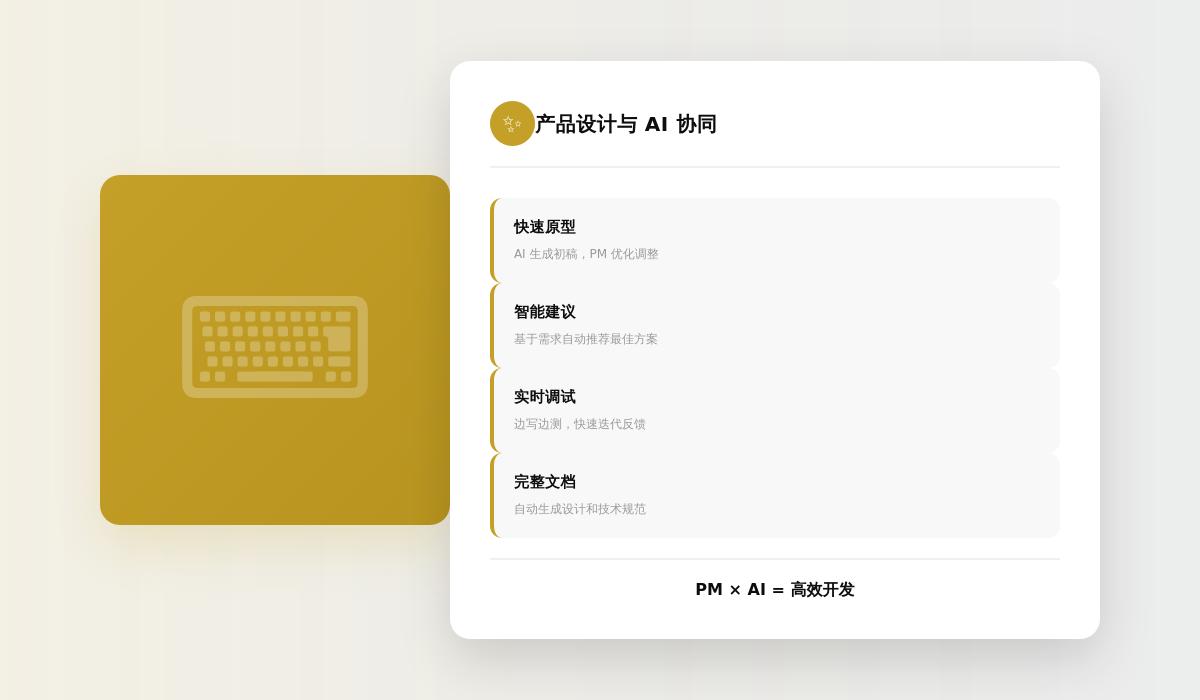
AI is an amplifier. When you provide it with precise requirements, it amplifies your efficiency—what used to take a development team two weeks to accomplish, you can now complete in an afternoon. If you give it vague requirements, it amplifies your confusion—resulting in outputs riddled with flaws, where fixing one issue causes three others to break, ultimately making it slower to redo than to start from scratch.
The difference isn’t in the tools. The difference lies in the quality of the input you provide to AI.
And the quality of the input depends on whether you can think clearly: who is this product for, what are the core scenarios, what does success look like, how is failure handled, and where are the boundaries?
These capabilities are what product managers have honed over many years.
User insights help you define “who it’s for.” Requirement breakdown helps you define “what to do.” Boundary thinking helps you define “what not to do.” Acceptance criteria help you define “what completion looks like.”
These are not new skills. They are the basics for PMs.
But in the VibeCoding era, these basic skills have finally translated directly into productivity—previously, you wrote a PRD and handed it to development, with a layer of communication loss in between; now, you write a requirement description and hand it to AI, seeing a runnable product in just five minutes.
The quality of the PRD directly determines the quality of the output.
Thus, I say, in the wave of VibeCoding, the most valuable skill for product managers has changed—not knowing how to code or use AI tools, but the ability you have honed over many years: turning vague ideas into precise requirements.
This ability was once called “writing PRDs.” Now it’s called “communicating with AI.” The essence remains the same.
AI is an instrument. The ability to describe requirements is the musicality.
Those with musicality can produce beautiful melodies with good instruments. Those without musicality can only play a sequence of notes, no matter how good the instrument.
This is a good thing for product managers, who have refined their musicality over many years. AI has improved the instruments.
Comments
Discussion is powered by Giscus (GitHub Discussions). Add
repo,repoID,category, andcategoryIDunder[params.comments.giscus]inhugo.tomlusing the values from the Giscus setup tool.