Claude Blocks OpenClaw
In recent months, OpenClaw has gained significant popularity, but during the recent Qingming holiday, some users faced unexpected challenges.
On April 5, AI giant Anthropic announced that its Claude model would no longer support third-party integrations, including OpenClaw. Users wishing to continue using the model must now opt for a pay-as-you-go plan, incurring additional costs.

Claude is integrated into Palantir’s “Maven Intelligence System” battlefield intelligence platform. Reports indicate that Claude analyzes confidential data from satellites, monitoring systems, and other intelligence sources to provide real-time target prioritization for military operations in Iran, thus elevating the model’s status.
However, the news of Claude blocking OpenClaw has led to widespread discontent on social media. This move means that thousands of users who rely on this powerful programming model will be forced into an expensive pay-as-you-go model, facing exorbitant computing bills. Boris Cherny, head of Claude Code, explained on social media platform X that the subscription service was not designed for third-party tool usage, and the ban was implemented to balance server resources for better sustainability.
Users seem unconvinced by this explanation, and discussions quickly shifted from technical aspects to commercial competition, with various conspiracy theories emerging, particularly the claim that the “father of OpenClaw” was poached.
The Ban’s Impact: OpenClaw Users React
The “father of OpenClaw” refers to developer Peter Steinberger, who initially created a tool called “ClawdBot” based on Claude, later renamed to OpenClaw at Anthropic’s request. Steinberger is well-acquainted with Claude’s ecosystem. Recently, he was recruited by Anthropic’s competitor, OpenAI, a timing that raises eyebrows given the proximity to the ban.
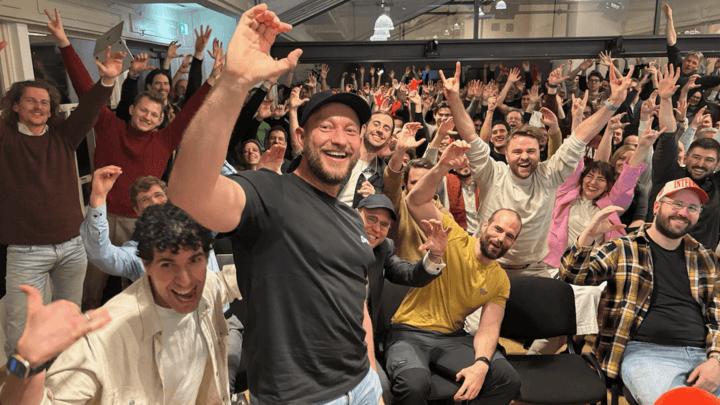
On February 14, Steinberger announced his move to OpenAI on his personal account.
Additionally, just two weeks prior, Anthropic had introduced the “Computer Use” capability for Claude, allowing users to have Claude operate their Mac computers, similar to OpenClaw’s functionality.
Connecting these events suggests a typical business strategy: if a competitor poaches my core developer, I replace their third-party tool with an official feature and cut off their subscription access, forcing users to either adopt my official solution or pay a high price. This narrative seems plausible and even satisfying.
However, Xiaomi’s MiMo model head, Rofo Li, believes the situation is more complex than mere commercial retaliation. On April 7, she published a detailed analysis on her social media account, sharing her insights on the incident in relation to Xiaomi’s recent “Token Plan” for resource allocation.
Rofo Li’s Analysis of Computing Costs
Rofo Li argues that Claude Code’s subscription model is a well-designed system for balancing resource allocation, but it may not be profitable and could even incur losses unless Claude’s API profit margins reach 10 to 20 times. She found that OpenClaw’s context management is poor, leading to multiple low-value tool calls per user query, each with long context windows (often exceeding 100,000 tokens), resulting in significant waste even with cache hits.
Moreover, many third-party tools compress raw data returned by tools every three steps when nearing the context limits of a large model, which requires recalculating due to changes in cached content, leading to low cache hit rates and increased costs and latency.
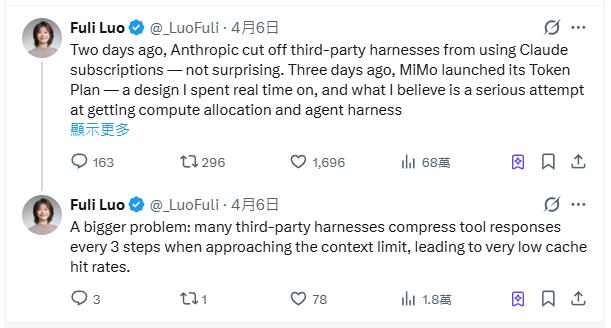
These factors combined result in actual request counts per query that exceed those of Claude Code’s framework by several times. In terms of API pricing, the actual costs could be dozens of times the subscription price, creating a significant gap. This means Anthropic is effectively subsidizing each OpenClaw user, and as OpenClaw grows in popularity, Anthropic’s losses increase.
“Short-term, these OpenClaw users may experience pain as costs soar by dozens of times,” Rofo Li stated. “But this pressure will drive improvements in context management, maximizing cache hit rates to reuse processed contexts and reduce wasted computing resources. Pain ultimately transforms into engineering standards.”
Rofo Li cautioned that large model companies should avoid blindly engaging in price wars until they find a way to design a non-loss-making pricing scheme. Selling computing power at extremely low prices while keeping doors open for third-party tools may seem appealing to users but is a trap, as it leads to low-quality tools and unstable, slow inference services. The end result is that users still accomplish nothing, which is unsustainable for both user experience and retention.
Currently, the global computing capacity cannot meet the demand generated by intelligent agents. Therefore, Rofo Li believes that the real solution is not cheaper computing power but collaborative evolution, combining more efficient intelligent tools with more efficient models. Anthropic’s actions, whether intentional or not, are pushing the entire industry ecosystem in this direction, which could be a good thing. The era of intelligent agents does not belong to those who consume the most computing power; it belongs to those who use it most wisely.
Ending Computing Anxiety with an Efficiency Revolution
Rofo Li’s analysis of the OpenClaw ban by Anthropic highlights the deep-rooted issue of computing waste in the current AI industry, reminiscent of the “DeepSeek moment” that shook the global AI sector in early 2025.
At that time, “computing anxiety” drove NVIDIA’s stock prices up, but the emergence of DeepSeek-R1, with incremental training costs of only $294,000, demonstrated that even with the approximately $6 million base model development cost, the overall expenses remained far below industry averages, while its performance was comparable to models developed by OpenAI at several hundred million dollars.

On March 27, Rofo Li shared the core value points of OpenClaw at a roundtable forum during the Zhongguancun Forum annual meeting.
Having participated in the development of DeepSeek, Rofo Li understands the significance of efficiency under structural innovation. DeepSeek’s success did not rely on the market’s hype of GPU clusters but on engineering implementations of sparse attention and maximizing cost-performance under limited computing power, achieving a synergy of algorithmic innovation and engineering optimization. As Rofo Li previously stated at the Zhongguancun Forum, the advantage of Chinese large model teams lies in pursuing maximum efficiency through structural innovation under low-end computing constraints.
However, as AI technology proliferates across various industries, technical bottlenecks have led to significant computing waste, and “computing anxiety” has resurfaced, severely driving up memory prices. The market’s default equation of “computing power = performance” is essentially an illusion of scarcity. The massive memory demands of computing chips have led many smartphone manufacturers to announce price hikes and delays in consumer-grade graphics cards, ultimately impacting ordinary consumers.
Taking a step back, DeepSeek has already provided feasibility, and this year, the rebirth of OpenClaw will undoubtedly begin with efficiency optimization.
Comments
Discussion is powered by Giscus (GitHub Discussions). Add
repo,repoID,category, andcategoryIDunder[params.comments.giscus]inhugo.tomlusing the values from the Giscus setup tool.