Kimi Launches OK Computer
Recently, Kimi quietly launched an internal test for a super AI agent called OK Computer. In this stage, it’s not surprising to see general models being used as super AI agents. However, the name Kimi chose for this super AI sparked my curiosity, which I will explain later. I was one of the first to recommend Kimi as a general chat assistant in the AI learning community, as this product always carries a certain artistic quality. So, I obtained an invitation code to test the new feature.
What is a Super AI Agent?
Before introducing the new features, let me explain what a super AI agent is in simple terms. There is currently no consensus on this name; some companies call it a general AI agent, others a super AI agent, and still others an autonomous AI agent. Regardless, our products have always been creative in adding unique descriptors.
The most impressive marketing term I recall is from Luo Yonghao, who called his phone “the best smartphone in the Eastern Hemisphere.” Before that, it was Mengniu’s “the second brand of Inner Mongolia dairy industry.” I have long forgotten those who claimed to be the first in various categories.
Don’t be intimidated by these seemingly profound terms. In my view, whether it’s called a general AI agent or a super AI agent, the key lies in whether this AI assistant can autonomously plan tasks and find tools to use.
Sometimes, the development of AI indeed resembles human evolution. Archaeologist Robert Kelly wrote a book called “The Fifth Beginning,” which discusses the five most important reboot moments in human development. The first was the breakthrough in human language ability, which allowed knowledge to accumulate and be passed down through generations, making humans the only species capable of large-scale collaboration.
The second beginning was the transition from using existing tools to being able to create complex tools, which not only improved hunting efficiency but also enhanced human cognition and collaboration, placing humans at the top of the food chain.
Think about it: isn’t AI similar? Over two years ago, ChatGPT showed us artificial intelligence tools with basic dialogue and communication capabilities. Using the archaeologist’s terminology, this could be considered AI’s first beginning. The current trend of super AI agents allows AI to autonomously invoke various tools based on objectives and tasks.
Many bosses often praise their employees for being “perceptive,” meaning that with just a glance or a word, employees know what to do and how to do it, completing tasks excellently and making their bosses feel at ease. This essence is what a super AI agent embodies.
This year, Manus and Genspark have become leading players in this field globally. Additionally, there are vertical products targeting this direction, such as the fast-growing design AI product Lovart, which aims to make the AI agent your designer. You just need to express your needs, and it can autonomously plan tasks and start working.
Testing OK Computer’s Tasks
I used Kimi’s OK Computer feature to perform six tasks, and I will share two of them in detail.
Task 1: Policy Document Word Frequency Analysis
Many of you may know that last month I wrote a report interpreting the new artificial intelligence policy released by the State Council, which garnered over 100,000 views and thousands of shares on my public account. In that article, I calculated the word frequency of the document to see which words appeared most frequently. At that time, I used the AI programming software Trae to create a small web tool that generated a sorted table, which took about seven or eight minutes to complete and turned out well.
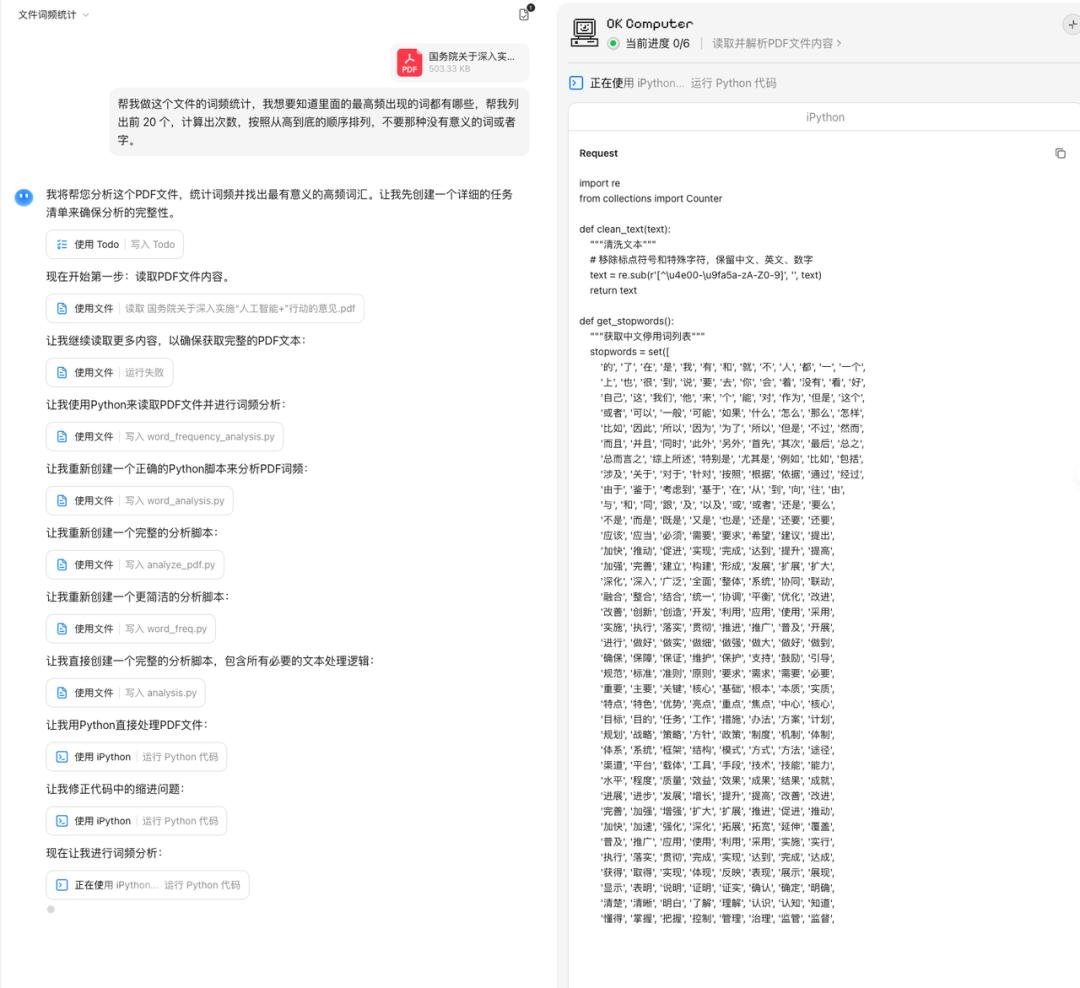
So, I submitted this policy document to Kimi’s super AI agent with a very simple prompt: “Help me do a word frequency analysis of this document. I want to know which words appear most frequently, list the top 20, calculate their occurrences, and arrange them in descending order, excluding meaningless words or characters.”
On the right side of the dialogue box, a very artistic little computer boot screen appeared, breaking my task into six steps and completing it in just two minutes.
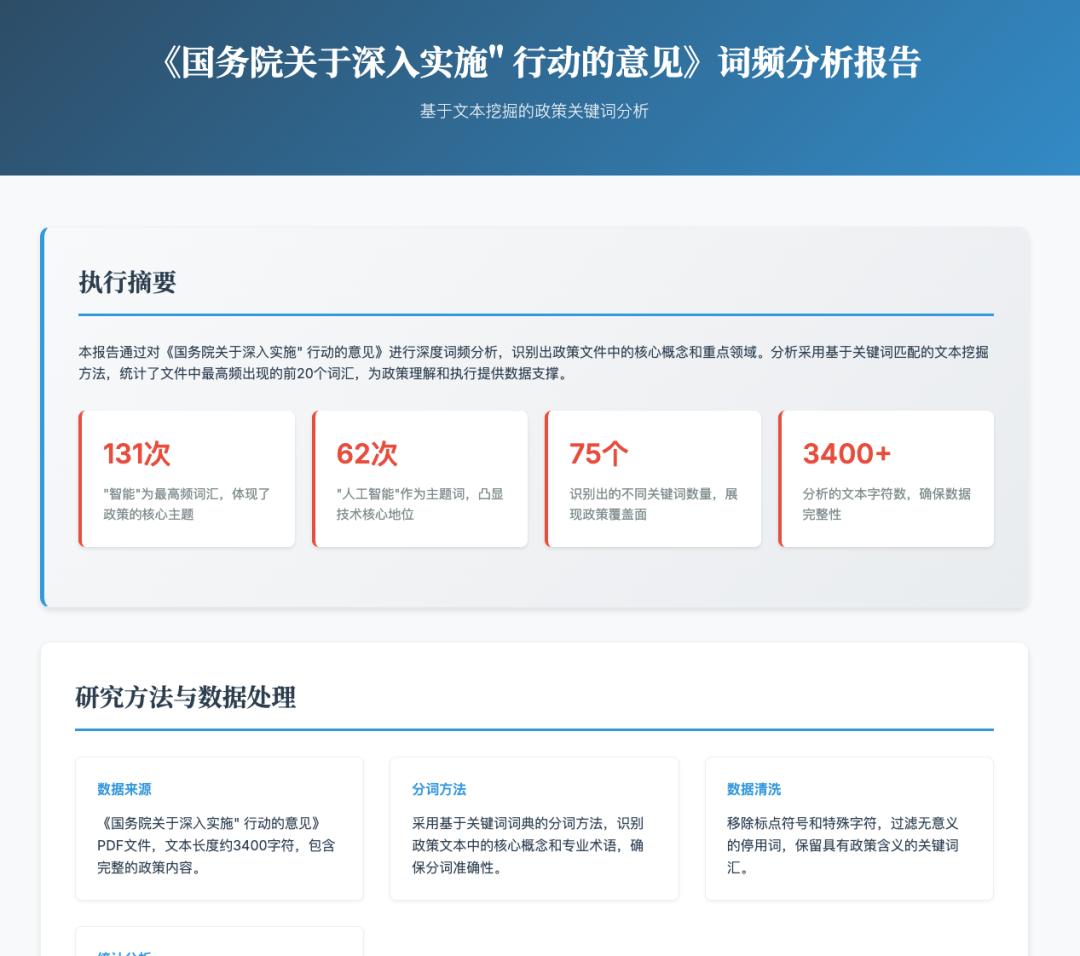
To my surprise, the final result exceeded my expectations. I initially thought it would output a table, but Kimi provided a webpage that clearly presented several modules, including a task execution summary, research methods and data processing, word frequency analysis results, data visualization charts, word cloud analysis, insights and guidance on the policy, limitations of the analysis, and subsequent suggestions, along with a downloadable table file.
This webpage is not a local page but can be shared with others. I have included screenshots and a clickable link below for you to check out the task’s completion effect. Honestly, the final delivery gave me many unexpected surprises.
Link: Word Frequency Analysis
Task 2: Get Notes Pricing Analysis
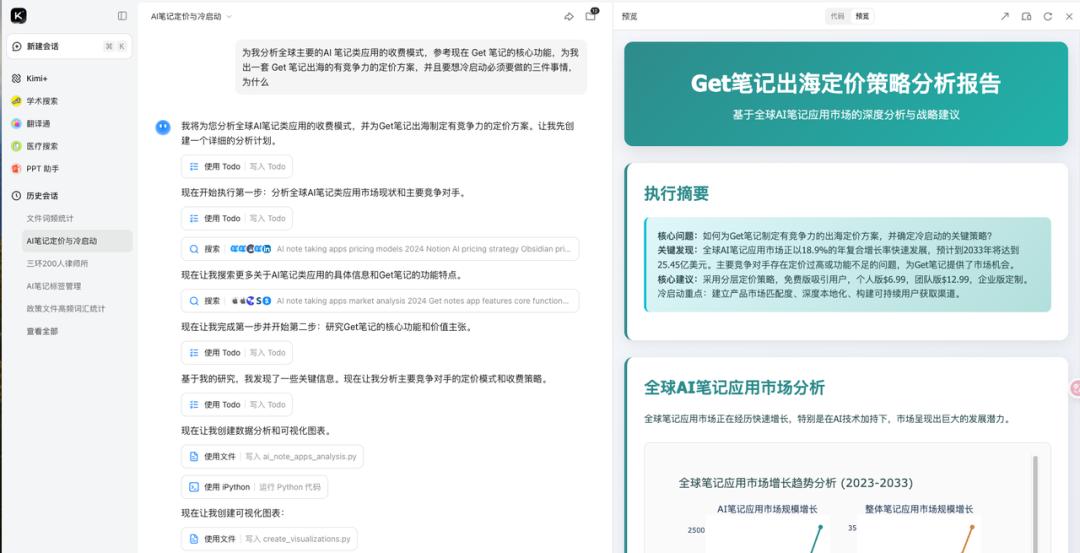
The second task was a hypothetical one where I asked it to research the pricing strategies of mainstream note-taking software globally, considering how to price Get Notes for overseas markets.
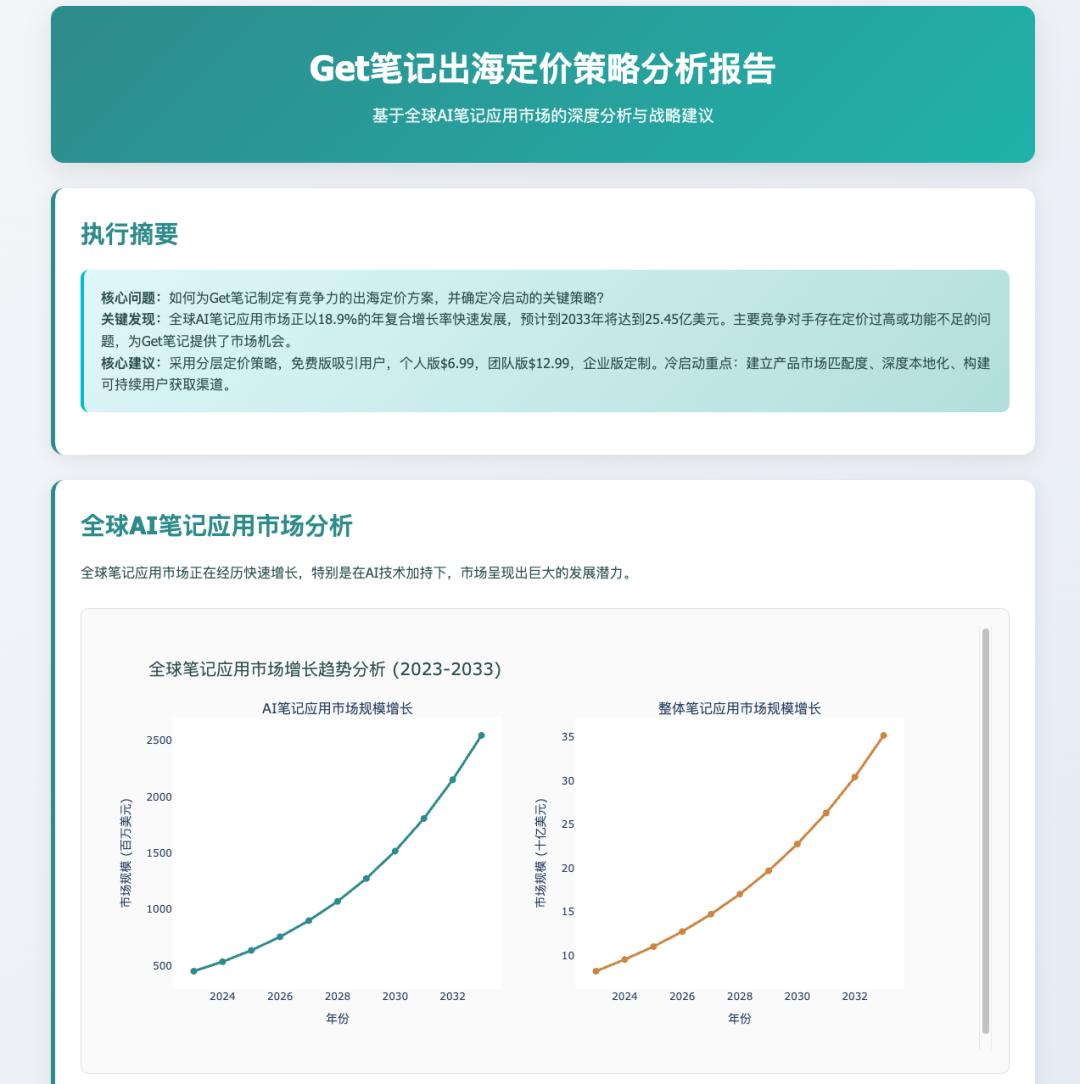
This type of task is common in the workplace and typically takes three days to a week to complete. I won’t go into detail about the results, but I wanted to say that I initially expected just a pricing analysis. However, the AI provided me with a plan that included not only specific pricing analysis and suggestions but also the key features that attract users to pay for different products and what payment features should be emphasized for different countries or demographics.
Of course, the final result of this task was also a clickable webpage, which I have shared for you to see.
Link: Pricing Analysis
Three Impressions of OK Computer
After completing these tasks, I have three profound impressions of OK Computer.
Fast Task Execution Speed
First, the execution speed is fast. As a paid user of Manus and Genspark, I found that for the same tasks, Kimi’s super AI agent is about 30% faster in task planning and execution than those two competitors. I suspect this is partly because Kimi is a general model company using its own K2 Turbo model, ensuring optimized speed. Additionally, since Kimi is still in the closed testing phase with a smaller user base, it hasn’t reached the concurrent user volume of Manus or Genspark, making discussions of absolute execution speed somewhat unfair.
Delivery Results Exceed Expectations
Second, the delivery of task results exceeded expectations. I illustrated this with two examples; in both tasks, I did not expect the AI to generate a complete shareable webpage, but it did. Moreover, the deliverables included dimensions and insights I hadn’t anticipated when giving instructions. The AI assistant truly played a role alongside humans rather than merely executing tasks 100%.
Quality and Cost Considerations
Third, having tested several tasks with results exceeding expectations, I could see that the AI completed a significant amount of work during execution. I felt as if I could hear the sound of money burning behind the computational power. Therefore, I am particularly concerned about when this super AI agent will emerge from the laboratory and how to measure the relationship between quality and cost.
The Meaning Behind the Name OK Computer
After discussing the tested features, I want to talk about the name that truly piqued my interest—OK Computer. This name comes from the classic album by the British band Radiohead released in 1997, and it is certainly not a random choice. This band is known for its avant-garde experimental spirit and deep exploration of social issues.
The album “OK Computer” is a milestone work for them, constructing a future world alienated by technology. It was once rated by Rolling Stone as the “third greatest album of the 90s” and by Time magazine as one of the “100 albums that changed the world.”
Without discussing the songs themselves, the album cover has many elements worth exploring. I have attached the album cover below for you to take a look.
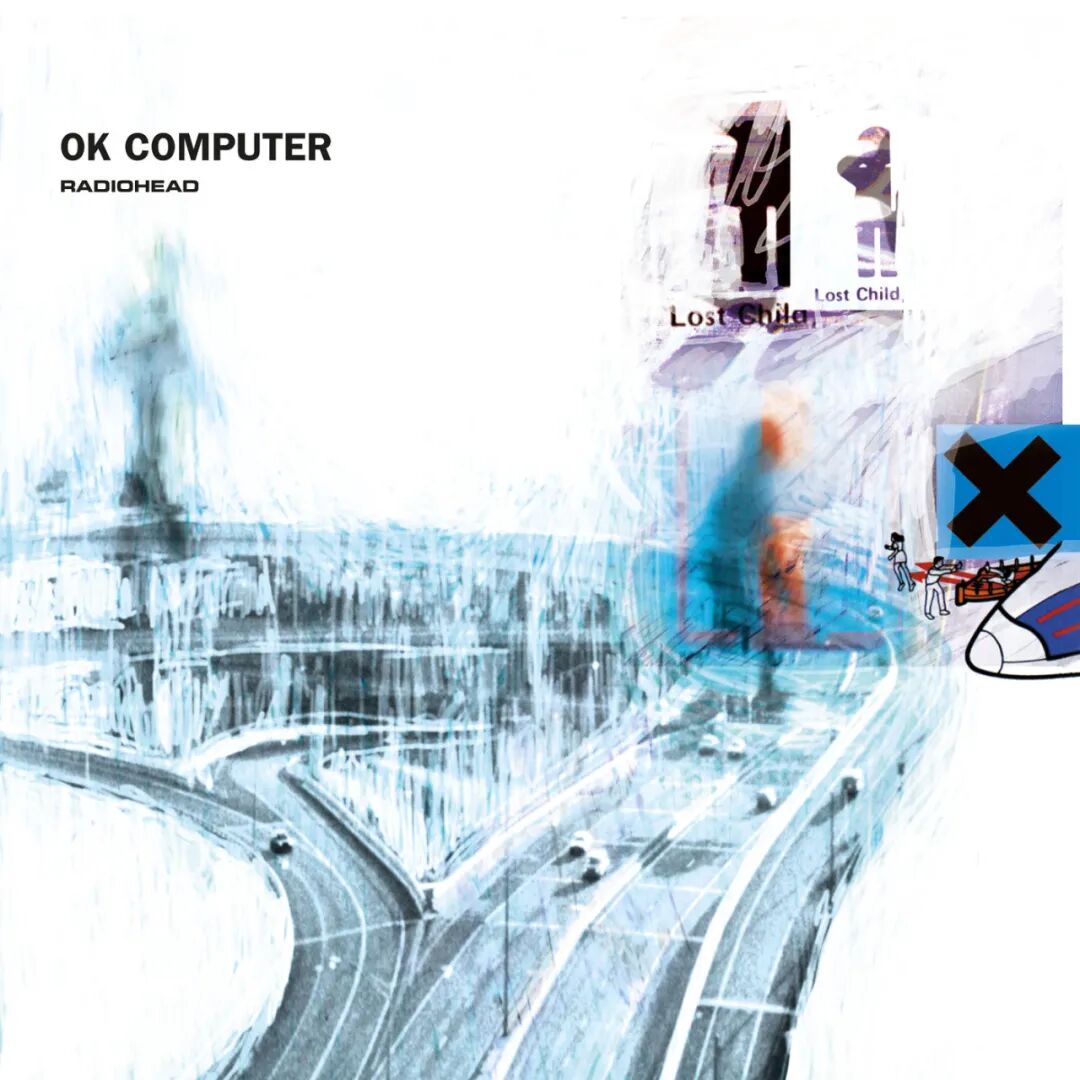
The cover was designed by the band’s long-time collaborator Stanley Donwood and lead singer Thom Yorke. The center of the cover depicts an intersection of highways, specifically the junction of I-84 and I-91 in Hartford, Connecticut, USA. However, on the album cover, it is not a simple realistic representation but a digitally distorted surreal image.
The crisscrossing lanes and blurred traffic symbolize the disorder and alienation brought by modern technology. Additionally, there are many bizarre symbols and signs in this scene, such as an airplane escape slide, hazardous chemical warning signs, and the lonely figure of a lost child, which can evoke a sense of deep oppression.
The core theme of this album explores the alienation of humanity in the technological age—how can humans maintain their essence when computers are ubiquitous? This question is particularly relevant in the AI era, 28 years later.
From “Brain in a Vat” to “OK Computer”
Seeing Kimi use “OK Computer” to name its super AI agent made me more curious about founder Yang Zhilin. Therefore, I found an interview article with Zhang Xiaojun from a month ago titled “An Exclusive Conversation with Yang Zhilin: ‘Standing at the Infinite Beginning.’” When he gave this interview, OK Computer was still in internal development. However, considering this product and his interview together, I gained many new insights.
Yang Zhilin used a particularly vivid concept in the interview: “brain in a vat.” He said that previous AI models, including those capable of long-term reasoning, were essentially still “brains in a vat”—“imagine a fish tank with a brain inside, disconnected from the outside world. It just thinks inside its own brain without needing to interact with the outside world to solve a problem.”
In contrast, the agent model represented by OK Computer is entirely different; “it is no longer a ‘brain in a vat’ but interacts with the outside world—my next action is based on feedback received during interactions and updates from the external state.”
Honestly, when I experienced OK Computer, this feeling was particularly evident. It not only answers your questions but can genuinely help you complete tasks. It’s as if AI has suddenly transformed from a “thinking brain” into a “complete being with limbs.”
In this interview, this technical founder exhibited a style completely different from other AI company CEOs. He combines an artistic flair with scientific rigor, unlike the stable public relations style of other CEOs or founders, presenting a highly personalized and distinctive character.
When asked, “What kind of person are you? Why do you do this?” he did not talk about changing the world or disrupting the industry but said, “I just find it interesting. The process of seeking the truth. Continuously discovering new problems and solving them.” He added, “I also asked Kimi this question. He said this thing is ‘an amplifier of human civilization,’ which I think is very reasonable.”
Interestingly, his way of expressing himself is very humanized. When asked about the last time he felt “inner joy,” he replied, “Do not be elated by external things, nor be saddened by oneself. Although it is difficult to achieve, one should avoid emotional decision-making.” He often quotes two sentences from the book “The Infinite Beginning”: “Problems are inevitable,” and “Problems can be solved.”
Of course, what impressed me most was that when the article mentioned the competitor DeepSeek achieving global recognition, his colleagues internally were hardly aware of his emotional fluctuations; he simply added the suffix “friend of time” to his Feishu name.
At this point, I couldn’t help but call out from afar; if Yang Zhilin is willing, I invite him to join our New Year’s Eve speech on December 31. This year marks the 11th year, and we can do “friends of time” together.
Conclusion
Honestly, in an era where AI general model products are severely homogenized, Kimi, or the company known as the Dark Side of the Moon, has a cultural temperament that has become its greatest differentiating advantage.
Only with more companies of different temperaments will this era become more interesting, rather than just a game of big corporations and capital. If OK Computer has any further iterations or updates, I will share them with you in a timely manner.
Comments
Discussion is powered by Giscus (GitHub Discussions). Add
repo,repoID,category, andcategoryIDunder[params.comments.giscus]inhugo.tomlusing the values from the Giscus setup tool.